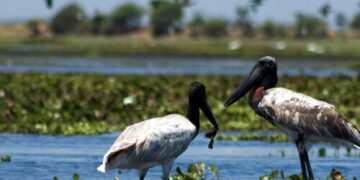




The Maya were landscape engineers on a grand scale, even when it came to fishing.
On the eve of the rise of the Maya civilization, people living in what’s now Belize turned a whole wetland into a giant network of fish traps big enough to feed thousands of people.
We already know that the Maya turned swamps into breadbaskets by draining and building raised blocks of land for maize fields. However, a recent survey of a wetland in what’s now Belize suggests that the rise of the Maya civilization was fueled not just by maize but by tons of fish every year. University of New Hampshire archaeologist Eleanor Harrison-Buck and her colleagues recently mapped a network of channels and ponds for trapping fish, built just before the Maya civilization rose to prominence.
Fish in a barrel
Harrison-Buck and her fellow archeologists used drones and Google Earth data to map 108 kilometers of ancient channels that zigzag across 42 square kilometers of wetland in Belize’s Crooked Tree Wildlife Sanctuary. The result is a network of channels and ponds that looks remarkably like the fish traps found farther south in Bolivia, built several centuries after the ones at Crooked Tree. Radiocarbon dating of material buried in the bottom of one channel suggests that the network has been around for at least 4,000 years.
If Harrison-Buck and her colleagues are right, the channels, along with a series of ponds, are a system for trapping fish by channeling receding floodwaters into the ponds. In the ponds, harvesting the fish would have been easy—just like spearing fish in a barrel (or a small pond).
The Crooked Tree Wildlife Sanctuary is a sprawling marshy grassland dotted with lakes and cut by streams. During the wet season, floods submerge the marshes and fish gather to spawn, as they’ve done for thousands of years (at least). As the water recedes and the dry season sets in, retreating fish escape down the zigzag channels dug into the landscape, right into the ponds. And once the water levels drop even further, the fish in the ponds have no way to escape.
Harrison-Buck and her colleagues calculated that at its peak, the system could have produced enough fish each year to feed around 15,000 people. That’s based on modern estimates of how many kilograms of fish people eat every year, combined with measurements of how many kilograms of fish people in Zambia harvest with similar traps. Of course, people at Crooked Tree would have needed to preserve the fish somehow, probably by salting, drying, or smoking them.
“Fisheries were more than capable of supporting year-round sedentarism and the emergence of complex society characteristic of Pre-Columbian Maya civilization in this area,” write Harrison-Buck and her colleagues.
When we think about the Maya economy, we think of canal networks and ditched or terraced fields. In just one patch of what’s now Guatemala, a lidar survey revealed that Maya farmers drained thousands of acres of swampy wetland and built raised fields for maize, crossed by a grid of irrigation canals. To feed the ancient city of Holmul, the Maya turned a swamp into a breadbasket. But at least some of their precursors may have made it big on fish, not grain. The common feature, though, is an absolute lack of any chill whatsoever when it came to re-engineering whole landscapes to produce food.
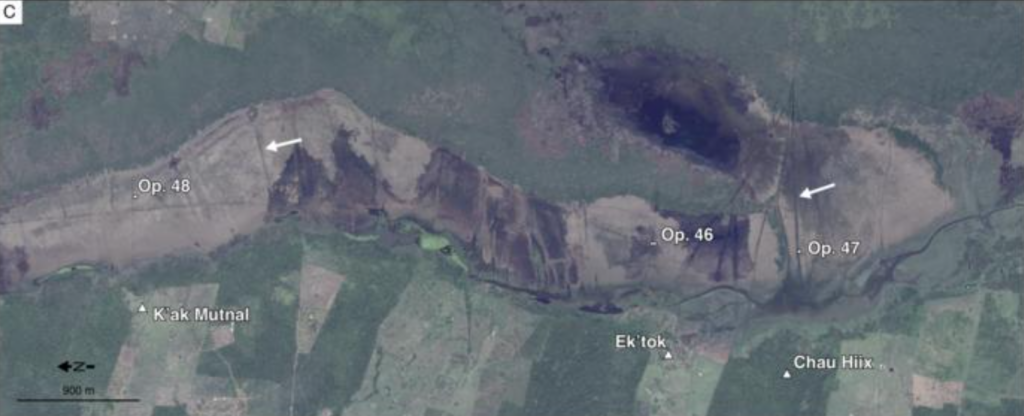
This Google Earth image shows the area containing the ancient fishery.
Infrastructure built to last and last
From the ground, the channels that funneled fish into nearby ponds are nearly invisible today. But from above, especially during the dry season, they stand in stark contrast to the land around them, because vegetation grows rich and green in the moist soil at the base of the channels, even while everything around it dries up. That made aerial photography the perfect way to map them.
In three of the channels, Harrison-Buck and her colleagues took samples of peat, which would once have lain in the bottom of the freshly dug passage, for radiocarbon testing. The results suggest that the channel had been there since at least 2000 BCE. That’s about 200 years before the start of the Formative Period, which marks the beginning of the rise of Maya civilization. (The Formative Period is also called the Preclassic Period; the period just before this is called the Archaic, so the channels were built very late in the Archaic Period.)
The Maya evidently kept using the fish-trapping system even as their civilization grew and consolidated into large urban centers. Harrison-Buck and her colleagues found bits of Preclassic Maya pottery in some of the lower layers of sediment that had filled the channels, and other archaeologists have excavated once densely populated Maya communities along the shore of the Western Lagoon.
There’s no sign that the Preclassic Maya did much to maintain the system of channels and ponds, though. Today, most of the channels have filled in with sediment, carried in by floodwaters, making them just subtle, curved dips in the ground, about 20 centimeters deep and 15 to 20 meters wide.
But even now, the ancient channel system still works. “While these features have filled in somewhat over the years, locals inform us that the ponds still concentrate fish during the dry season today,” write Harrison-Buck and her colleagues.
Science Advances, 2017. DOI: 10.1126/sciadv.adq1444 (About DOIs).

Kiona is a freelance science journalist and resident archaeology nerd at Ars Technica.